Bringing an intersectional lens to data ethics in policy and decision-making
Author: GIZ (Deutsche Gesellschaft für Internationale Zusammenarbeit) Data2Policy, in collaboration with the Global Project FAST (Feminism in Action for Structural Transformation
Bringing an intersectional lens to data ethics in policy and decision-making
Evidence-based decision-making can inform policies that are more inclusive, more efficient, and effective. At the same time, these policies often fall short of achieving such desired outcomes if certain criteria are not met. This is evident in our project implementation experience, where we have observed several public data related projects unintentionally excluding the very groups they aim to serve. This shortfall can often be attributed to biased and incomplete data systems — a challenge that carries both political and technical implications. Addressing it means asking not just how data is collected, but who it is collected by, for whom, and to what end.
Are the relevant stakeholders involved in the decision-making process? Is the data complete and reliable? Is it possible to establish a baseline against the desired change after the intervention?
Data Feminism offers one such lens. Within the scope of data production and use, many tools that focus on ethics deal with risk mitigation, such as preventing harm, protecting privacy, correcting bias, and ensuring compliance with ‘do no harm’ principles. In data-driven projects designed to inform public policy, and where policy decisions allocate resources, shape priorities, and institutionalize power, data design itself must acknowledge and account for how resources are allocated, whose priorities are centred, and how power is institutionalized. In this sense, power refers to the ability to influence what data is collected, how it is funded and resourced, how it is interpreted, whose experiences become visible, and ultimately how public policies and decisions are made.
Acknowledging that data is never neutral enables policymakers to look beyond containment as the key mode of data ethics, and shift understanding from “How do we avoid harm?” to “Who benefits, who is represented, and who decides?” This means looking closer at what data gets collected, how it is framed, used, analysed and presented.
When data has the power to render issues visible or invisible, to frame problems in ways that privilege certain solutions, and to define whose experiences count as evidence, a theoretical and methodological framework becomes necessary to hold this complexity around questions of power dynamics. Ethical data production and use must therefore interrogate not only bias within datasets, but also the structural design choices that shape what is measured, how categories are constructed (who is represented), and how findings are aggregated and presented.
Data processes become a site where power dynamics are either kept, re-shaped or transformed.
Gender transformative interventions need evidence, baselines and data to efficiently address the root causes of inequality. This is done through the design of indicators, classifications, and digital tools that enable monitoring, evaluation and decision-making. A feminist approach to data shifts the focus from bias correction to structural design interrogation. It asks not only whether data is accurate or fair, but whether the conceptual container within which data is collected and visualized serves the purpose of equity.
Data Feminism, as championed by Catherine D’Ignazio and Lauren Klein, provides seven key principles with which to consider data through a power critical lens. It encourages not only the acknowledgement and responsiveness to relations of power, but the importance of context, valuing local knowledges, lived experiences, overcoming strict binaries and making labour visible. This gives us a way to ask harder questions about indicator design, aggregation, and classification.
Applying the lens
Mapping the data ecosystem
The Open Data Institute (ODI) data ecosystem mapping method provides a structured approach for analyzing how data is produced, shared, and used across a given system. Rather than focusing on individual datasets, it examines the interactions and dynamics between actors — including public institutions, private sector entities, civil society organizations, and technical infrastructures — and the ways in which data flows between them.
The method involves identifying key stakeholders, mapping the types of data they generate or rely on, and assessing how these interactions are shaped by broader institutional, social, and economic conditions. By making these connections visible, the data ecosystem mapping helps to surface gaps in data availability, inefficiencies in data exchange, and underlying power dynamics that influence access and control.
As such, the approach is not only descriptive but diagnostic. It supports the identification of entry points for improving data governance, strengthening coordination, and enabling more effective and responsible data use across the system.
Frameworks such as Data Feminism can initially appear abstract. Concepts such as power, intersectionality, and positionality may seem theoretical or removed from day-to-day data practice. Making evident structural bias is less about adding complexity and more about asking more systematic questions.
Many practitioners already engage in elements of this work; however, the challenge lies in formalizing and systematizing these practices in ways in which structural bias can be consistently identified, examined, and addressed in durable ways.
We propose four levels of interrogation:
Level 1 – Interrogating the frame
This level requires us to ask what problem we are trying to solve and what counts as relevant evidence to answer it. Key questions include: What qualifies as “gender data” in this project?
Is gender limited to gender-based violence (GBV) statistics or maternal health indicators?
Which sectors are treated as neutral, and why?
Transport data, for example, is not often categorized as gender data. Yet when examined through a gender lens, it intersects directly with exposure to gender-based violence, access to unpaid care responsibilities, and economic mobility. When sectors are framed as neutral, power relations recede from view.
Zooming out to interrogate framing decisions reveals how inequality is distributed across systems rather than confined to designated gender topics. This meta-level inquiry surfaces bias at the level of agenda-setting and problem construction.
Level 2 – Interrogating the data life cycle
This level examines how bias can be introduced in data across its life cycle. Data often reflects decisions about categories, indicators, thresholds, labels, and visualization choices.
Recognizing that datasets are products of institutional and political processes raises critical questions:
When we talk about categorical data… who defined these categories?
Who funded the data collection?
What reporting requirements or institutional incentives shaped indicator selection?
What alternative categorizations might produce different insights?
For example:
Is ‘head of household’ coded as male by default?
Is gender captured as binary?
Are informal economies systematically undercounted?
Structural bias frequently resides in inherited defaults and standardized classifications that become institutionalized and rarely revisited. Surfacing it requires deliberate scrutiny of these underlying assumptions — not of the data’s accuracy, but of its claims to neutrality.
Level 3 – Interrogating disaggregation and representation
Structural bias can operate through aggregation. For example, when data is presented in aggregate form, patterns of exclusion may be obscured.Using GBV data as one example — though applicable to any dataset — practitioners can examine differences across:
Rural and urban contexts
Digitally literate and digitally excluded populations
Age groups (e.g., under 17, over 50)
Persons with disabilities
Migration status
Socioeconomic class
Beyond disaggregation, further questions emerge:
Who is missing entirely?
Who is systematically undercounted?
Why?
Absences may reflect access barriers, fear of reporting, digital exclusion, stigma, or political silencing. In this context, intersectionality functions as a methodological tool for disaggregation rather than a normative slogan. Without it, policy responses risk being designed for an abstract “average” user who rarely exists in practice.
Level 4 – Interrogating design, infrastructure, and access
At the level ofdesign, infrastructure, and access, we can see how structural bias can also be embedded in digital infrastructure.In the development of a digital public good — such as a gender dashboard — we might ask:
Who are the intended users?
Who are the assumed users?
Who may be excluded by design (language, bandwidth, digital literacy, accessibility requirements, safety)?
How might this tool function in high-risk environments?
A feminist lens in this context extends beyond user-centred design towards power-aware design. It acknowledges that infrastructure and usability decisions can either widen or reduce existing inequalities.
Applying a feminist lens is not about adopting and mastering a new theory, but simply and systematically interrogating the assumptions embedded within data systems and redesigning them where they reproduce inequality. In this way, data feminism is not an additive exercise, but rather a corrective one, shifting from presumed neutrality toward accountable data practice.
Turn ethics into design decisions: Blending data feminism principles in the data ethics canvas
The Data Ethics Canvas, developed by the Open Data Institute, offers a structured way to interrogate the ethical dimensions of data projects across their full life cycle. Rather than reducing ethics to compliance or risk mitigation, it deliberately creates space for critical reflection on purpose, stakeholders, potential impacts, and the wider systems in which data operates. It shifts the focus from what data is used to how decisions around data are made, who is affected by them, and where accountability ultimately sits. When combined with Data Feminism, the Data Ethics Canvas moves beyond procedural ethics and becomes a tool to surface structural questions—reframing ethics from managing risk to examining how power and inequality are embedded in data systems, and how these can be actively challenged and redesigned.
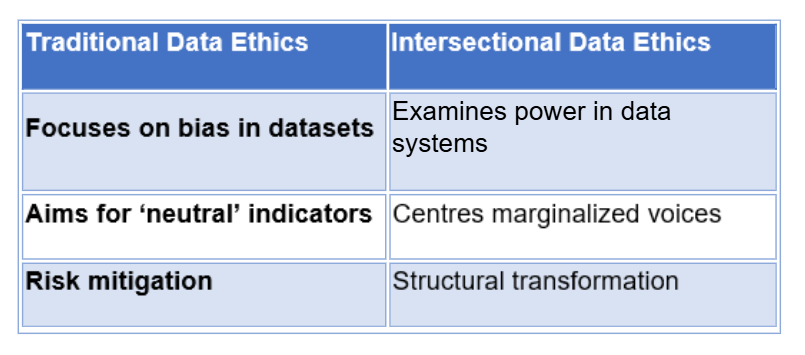
Considering this, if we wanted to approach data ethics from an intersectional perspective, we could summarize it in the following table:
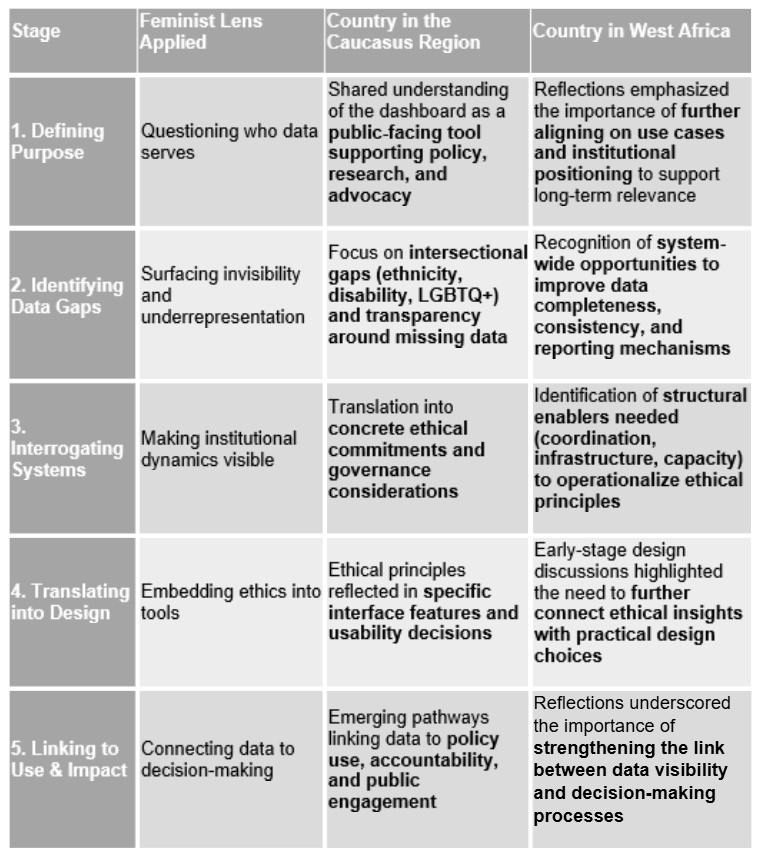
Based on both methodologies and experiences in two different contexts, this approach illustrates how combining the Data Ethics Canvas with a data feminism lens can practically translate abstract ethical principles into concrete design, governance, and decision-making. The table below highlights how this approach played out in early-stage workshops, as both case studies were intent on developing a gender dashboard on the national level.
Why this matters
What emerges from the workshops in both countries was not a single model of “good” data ethics, but a more grounded understanding of the conditions under which data ethics becomes operationally meaningful.
Across both contexts, the application of a feminist lens did not begin with the introduction of new tools, but with a shift in perspective. It reframed familiar technical concerns—such as data quality, access, and use—into structural questions of power: who defines the problem, whose realities are represented, and who ultimately benefits from the systems being designed.
The Data Ethics Canvas provided a structured entry point to surface these questions across the data lifecycle. The Data Feminism framework extended this reflection by situating data practices within broader systems of inequality. Taken together, these approaches revealed that many of the most critical ethical challenges are not located within datasets themselves, but in the surrounding conditions—fragmented institutional landscapes, unclear ownership and mandates, limited technical capacity, and limited integration between data production and decision-making.
The contrast between cases further illustrates this point. In the country in the Caucasus region, the combination of structured tools and reflective frameworks enabled participants to move from abstract discussion towards articulated commitments and emerging design directions. In the context of the West African country, by contrast, the same approach functioned more as a diagnostic mechanism—surfacing the absence of foundational conditions required to translate ethical reflection into practice and revealing the gap between ambition and institutional readiness.
This distinction is instructive. Without an intersectional and feminist lens, data systems risk reinforcing dominant narratives, excluding marginalized perspectives, and legitimizing incomplete or biased evidence. When applied effectively, however, such approaches can reposition data systems as instruments not only for describing inequality, but for interrogating and addressing it.
Ultimately, integrating Data Feminism into applied methodologies such as the Data Ethics Canvas is not about increasing conceptual complexity. It is about ensuring that data-informed policy processes are grounded in lived realities, responsive to diverse experiences, and accountable to those they are intended to serve.
Feedback
Thank you for your response!
If you wish to provide more detailed feedback, feel free to reach out to christophe.ji@undp.org